Appointment booking system, when you need more than time slots
A basic appointment booking system or appointment scheduler is useful when a customer chooses an available time slot, enters their details, receives a confirmation and the organizer sees the booking. For consulting, discovery calls, sales meetings, client scheduling or simple service appointments, this can be enough.
The problem begins when booking is no longer just about choosing an available slot. For group events, classes, workshops, training sessions, community programs or monthly cohorts, capacity is often limited, the event fills up, a waitlist starts and then someone cancels.
At that point, the real question is not whether there is an online registration form, an online scheduler or a booking page. The real question is what the system does with full capacity, the waitlist, the cancellation and the newly available seat. If this has to be tracked manually, spreadsheets, manual emails, misunderstandings and missed refill opportunities follow quickly.
Bookcessful was built for this situation. It is worth considering if you do not simply want a booking link or a scheduling app, but a system that also handles the operational problems around capacity.
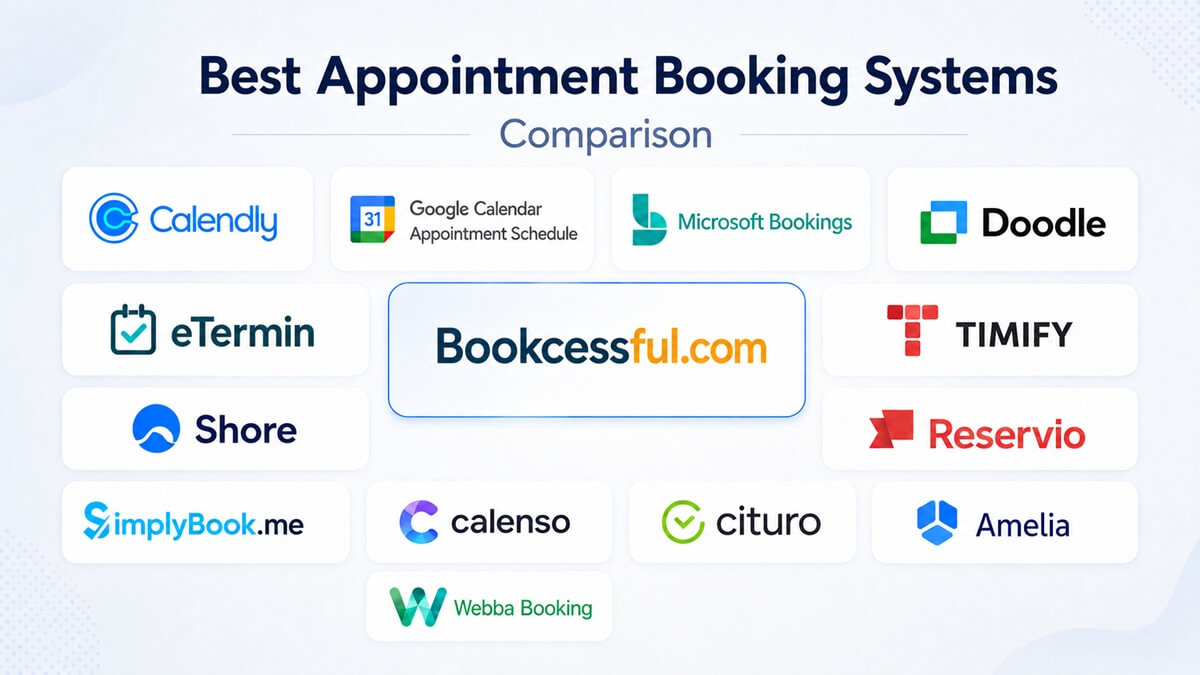
Calendly, Google Calendar Appointment Schedule or Cal.com can work well for simple scheduling and can act as a practical appointment scheduler. Reservio, Minup or Salonic may be a better fit for service-provider and salon-style workflows. Amelia, Webba Booking or other WordPress booking plugins can be useful if booking needs to live inside a WordPress website. Bookcessful is strongest when booking turns into sold-out capacity, waitlists and reorganization work.
That is why this page should not be read as a general list of booking tools or scheduling software. It is a decision guide: when a simple appointment booking app is enough, when a service-provider booking system or client scheduling software makes more sense, and when you need a system that takes capacity management seriously.
- For simple meeting scheduling: Calendly, Google Calendar Appointment Schedule, Cal.com or similar calendar-based appointment schedulers.
- For service-provider and salon-style booking: Reservio, Minup, Salonic or another online booking system connected to client scheduling and client management.
- For booking embedded in a WordPress website: Amelia, Webba Booking, WP Booking System or another booking plugin.
- For group events, sold-out sessions and waitlists: Bookcessful, when seat reallocation and capacity management matter.
graph TD
A[Online booking need]
B{Only time slots?}
C[Calendar booking may be enough]
D{Sold out or waitlist?}
E[Capacity management is needed]
F[Bookcessful]
A --> B
B -->|yes| C
B -->|no| D
D -->|yes| E
E --> F
If you already know that your problem is not just offering available slots, but managing sold-out sessions, waitlists and freed-up seats, do not start with a generic calendar tool or scheduling app. See which Bookcessful plan fits your workflow.
See plans and options