comparison
Position paper: Is Bookcessful suitable for one-to-one scheduling — or only for group bookings?
February 26, 2026
Can Bookcessful handle one-to-one scheduling — or is it only for groups? This position paper breaks down when capacity-driven logic still fits (capacity=1), when it’s the better choice, and how it compares to Calendly in real use cases.
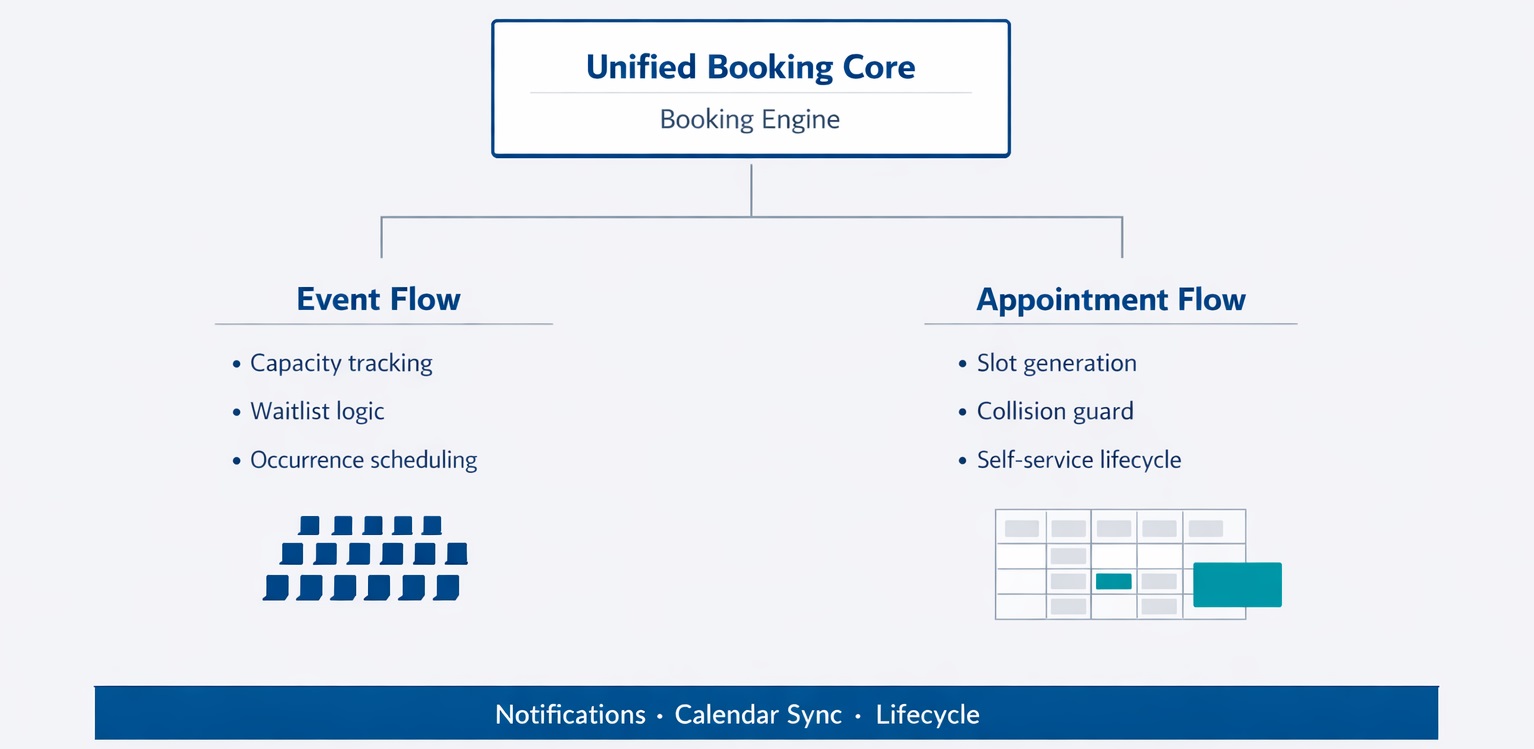
Starting point: Bookcessful is often positioned as a system built for group bookings, waitlists, and capacity management — while tools like Calendly are seen as the default for one-to-one scheduling. The common simplification is: “specialized system = not suitable for simple one-to-one use.”
This position paper challenges that assumption. The real question is not which tool is “better,” but what actually defines suitability in one-to-one scheduling — and whether Bookcessful meets those conditions. The analysis is based on the system’s actual data model, controller logic, and UI behavior (v1.8.5), not on marketing positioning.
1. Thesis and definitional framework
The core thesis: Bookcessful’s primary value lies in waitlist automation and capacity logic — but this does not make it unsuitable for one-to-one scheduling. The opposite is often true: in many cases, the same operational logic that handles capacity under load also improves reliability in simple booking flows.
A more precise statement: Bookcessful is fully viable for one-to-one use cases when the organization’s needs are defined by booking flow reliability (availability, conflict handling, cancellations, notifications) or when one-to-one and group bookings coexist and must be managed within a single system.
The key is to define “suitability” correctly. It is not a branding question — it is a functional one.
The minimum requirements of one-to-one scheduling are:
- Management of availability and free time slots (availability)
- Creation, modification (rescheduling), and deletion (cancellation) of bookings
- Conflict handling and resource locking (no double bookings)
- Confirmations and reminders (communication infrastructure)
- External calendar synchronization (Google/Outlook), if required
If a system reliably handles these, it is functionally suitable for one-to-one scheduling. Everything beyond that — CRM integrations, meeting workflows, hiring pipelines — is a question of scope and tool fit, not basic suitability.
2. Claims of the external Comparison document and the correct reading
The external comparison material (hereinafter: the “Comparison”) correctly states that Bookcessful’s focus is group, capacity-driven booking and waitlist/allocation logic, and also that Calendly is typically designed for one-to-one and “simple group slot” meeting scheduling with a strong integration ecosystem. At several points, the Comparison suggests an implicit conclusion: since Bookcessful is “niche” and of “narrower focus,” it is therefore “not as full-featured” for individual appointments. This slippage is what the Argument document explicitly challenges: the fact of specialization is not equivalent to unusability for one-to-one.
Important: the position paper does not dispute the risks listed by the Comparison (few independent reviews, smaller ecosystem, fewer integrations); it only asserts that these are not logical refutations of one-to-one suitability but rather vendor risk and fit decision factors.
3. The Comparison’s main logical error: “specialized” ≠ “unsuitable”
The central argument of the Argument document: one of the fundamental logical errors of the Comparison is that it derives “unsuitability” directly from the label “specialized.” This is a hidden premise: “what is not explicitly built for one-to-one is not good for one-to-one.” This premise is false in most software categories because:
- A system may be vertically optimized (e.g., capacity, waitlist) while still reliably delivering horizontal core functions.
- The functionality of one-to-one processes largely overlaps with group booking functions; the difference is typically the capacity parameter and downstream logic.
- If a system can correctly handle more complex N-capacity cases, that is a strong indicator it can also handle the capacity=1 (one-to-one) case — because that moves downward on the complexity scale.
The Comparison itself partly signals this logical gap when it acknowledges that Bookcessful “works with your existing calendars” and handles “bookings, capacity, waitlists, notifications and calendar integration” as a unified workflow — these already cover most of the one-to-one minimum. The debate is therefore not about whether Bookcessful can create bookings, but about how much of an “all-purpose” tool it is. But the latter is not identical to suitability.
4. Technical-functional argument: one-to-one is a special case of group booking
One of the strongest claims in the Argument document: in the one-to-one model, the event/slot capacity is 1. This is not a rhetorical trick but a system design fact. If a booking engine can handle capacity limits, booking state, and resource conflicts, then the “capacity=1” setting is technically a restricted configuration. The consequences:
- Capacity handling: N for group, 1 for individual — same engine, different parameterization.
- Availability handling: the “free/occupied” state logic is simpler in one-to-one because there is no partial fill.
- Cancellation and released capacity: equally business-critical (especially with high no-show), but here only one slot is freed.
- Notifications: confirmations and reminders run on the same infrastructure.
- Calendar sync: Google/Outlook integration is typically a “must-have” in one-to-one; according to the Comparison, this is present.
From this follows the Argument document’s proposition: one-to-one is not “foreign” to Bookcessful but a limited-capacity configuration. If someone claims Bookcessful is “unsuitable for one-to-one,” they would actually have to prove that Bookcessful cannot meet the above minimums — yet several elements of the Comparison imply the opposite.
5. Business argument: real operations are often hybrid, not binary
The Comparison paints a binary picture: Bookcessful = group; Calendly = one-to-one. This is understandable because comparisons need a clear axis. But at the decision-maker level this binary is often false, because many organizations operate in hybrid mode. The Argument document’s examples (intro consultation one-to-one, core service group, follow-up one-to-one) describe a typical pattern.
In hybrid operations, the largest hidden cost is not the booking itself but system fragmentation:
- Two admin interfaces, two “sources of truth” (calendar vs booking system), two customer data flows.
- Duplicated automations (email reminders, cancellation rules) in two places.
- Divergent status logics (what counts as booked, cancelled, waitlisted), which can cause errors and degrade customer experience.
One of Bookcessful’s implicit promises — also emphasized by the Comparison — is the unified workflow: bookings + capacity + waitlists + notifications + calendar integration. In hybrid scenarios this is not a “nice-to-have” but a structural advantage: it places the organization’s booking lifecycle under a single process engine.
6. Operational argument: the waitlist mindset also has value in one-to-one
The Comparison suggests that waitlists are a “group” problem. The Argument document points out that overbooking and capacity shortages also exist in one-to-one contexts, just in a different form. Typical cases:
- High-demand expert appointments (coach, therapist, consultant).
- Professionals working with limited weekly time slots (a few consultation hours/week).
- Short-notice cancellations where the biggest loss is an empty slot.
- Priority-based client segments (VIP, returning, subscriber) — here, “who gets the freed slot” is not trivial.
This is where Bookcessful’s “capacity recovery” concept appears: if freed capacity after a cancellation can be quickly and rule-based reallocated, utilization increases, lost revenue decreases, and admin work drops. Waitlist automation in one-to-one is therefore not aesthetic — it is a business KPI: the “ratio of empty time slots.”
7. Proper handling of the Comparison’s criticisms: real risks, but different category
The position paper’s task is not to “blur” the risks identified by the Comparison. These may be real and do matter at decision level. The key is to treat them in their proper place.
7.1 Few independent reviews / references
The Comparison states that large review sites have few or zero verified ratings, which reduces confidence derived from community feedback. This is a procurement risk, not a functional refutation. The correct response: pilot + measurable KPIs and explicit risk handling (SLA, support channel, data export, exit plan). (The Argument document records this logic: “risks, not refutations.”)
7.2 Smaller ecosystem and integrations
Calendly’s advantage is the integration ecosystem — according to the Comparison as well. But in the question of one-to-one suitability, this is decisive only if the company actually uses these complex integrations.
If the core process is:
- time selection,
- calendar conflict avoidance,
- confirmation/notification,
- cancellation/rescheduling handling,
then the specialized system can be fully adequate — especially if it provides extra automation on the group/capacity side (which the Comparison describes as Bookcessful’s main strength).
7.3 “Narrow audience” and “not as full-featured”
“Narrow audience” is not inherently negative: it often means the product fits better a specific problem. “Not as full-featured” is only a criticism if the missing features are critical for the organization. The debate material is mistaken if it generalizes this into “since it doesn’t do everything, it’s not good.” The decision question is: “What do we actually need?”
Supplementary evidence: Bookcessful is explicitly suitable for one-to-one appointment scheduling
The argument so far has shown from a logical and operational framework that Bookcessful cannot be excluded from the one-to-one scheduling category. However, in its current state the product supports an even stronger claim: it is not merely potentially suitable, but based on code-level operation it is actually suitable for production-grade individual appointment processes.
This conclusion does not follow from marketing positioning but from the existence of a separate appointment pipeline, dedicated slot engine, collision protection, full lifecycle handling, and automated test coverage within the system. Together these constitute functional proof.
1. First-class appointment flow, not a workaround
The system architecture does not attempt to force every case through a single “generic booking path.” Routing and control logic separate group events and individual appointments. This means the one-to-one operation is not a side branch or forced solution but an independently managed flow.
From a debate perspective this is key: where a separate pipeline exists at the product level, the “group-only system” narrative is no longer professionally sustainable.
2. Appointment mode is built on explicit type logic
The operation is not composed of heuristics or UI-level tricks. The individual booking path is tied to explicit service-type checks, meaning the system consciously treats the one-to-one use case separately.
This matters because the “may be suitable” category typically appears where a system can only indirectly perform a task. Here, however, the operation is type-driven, validated, and server-side protected. This indicates implementation maturity.
3. The decisive factor: dedicated slot engine and transactional collision protection
In one-to-one scheduling the real risk is not displaying the calendar but double booking and time-window inconsistency. Bookcessful’s appointment engine handles slot generation and resource conflicts in a dedicated service and performs transactional revalidation at booking time.
This operational pattern falls into the industry “production-ready” category because:
- slot generation is rule-based,
- resource conflicts are server-side validated,
- saving occurs in a locked transaction.
From a debate standpoint this is one of the strongest functional proofs that the system can be reliably operated in a one-to-one environment.
4. Full appointment lifecycle, not just time selection
The minimum of individual booking suitability is not displaying a slot list but managing the full customer lifecycle. In the system, the appointment flow covers:
- booking creation and status handling,
- self-service management,
- cancellation and rescheduling logic,
- notification and audit events.
This is no longer an “appointment picker widget” category but a functioning appointment lifecycle. From the debate perspective this separates demonstrative capability from real operational suitability.
5. The user interface also handles appointment mode separately
The public booking view is not a unified compromise but renders event and appointment modes separately. At the UX level this also shows the product does not support individual booking “by force” but deliberately treats it as a distinct user path.
Strategically this matters because the quality of the one-to-one experience is decided here: where separate view logic exists, the product can deliver a dedicated UX.
6. Automated test coverage: operation proven, not assumed
The strongest technical argument is explicit test coverage. Multiple feature and unit tests specifically verify critical points of appointment operation: slot isolation, validation matrix, post-booking redirect, self-service reschedule, etc.
From a debate perspective this is a qualitative leap. Where automated tests protect one-to-one behavior, the system operates not hypothetically but reproducibly. This is the point where the “may be suitable” claim can professionally be elevated to “is suitable.”
7. Architecture-level separation also on the iCal side
The time export logic handles appointment bookings and event occurrences separately. This again shows the platform natively supports two different booking models rather than forcing everything into one universal structure.
This type of separation is typical of mature booking architectures.
8. Why the strategic positioning still remains valid
It is important to see clearly: the fact that Bookcessful functions fully in one-to-one does not change the product’s strategic differentiation. The platform’s strongest competitive advantage remains waitlist and capacity automation.
The precise professional statement therefore reads:
- Bookcessful’s main differentiating power is capacity and waitlist intelligence,
- but based on the current implementation the system is also production-capable for individual appointment booking,
- and unifying the two operating modes on one platform is a clear structural advantage for certain organizations.
Closing conclusion
The available functional elements — separate appointment pipeline, dedicated slot engine, transactional collision protection, full lifecycle handling, and automated test coverage — together no longer indicate hypothetical suitability. Based on these, it is professionally defensible to state that Bookcessful is implemented and suitable for one-to-one appointment scheduling mode, while its differentiating strength remains waitlist-driven capacity intelligence.
8. Decision framework: when yes, when conditional, when no
The Argument document is useful because it does not make a dogmatic “good for everything” claim but sets conditions. The position paper further formalizes this to become decision-maker material.
8.1 Strong yes (Bookcessful is also a good choice for one-to-one)
- There is now or is expected mid-term a group component (workshop, course, training), and it is not desired to manage it in a separate system.
- Cancellation/no-show is high and rapid rebooking is business-critical (time capacity utilization).
- A unified customer experience and admin is important (one system, unified rules).
- Required integrations stop at calendar sync and basic notifications.
8.2 Conditional yes (Bookcessful can work, but pre-check required)
- Pure one-to-one operation with a simple process (service appointments, consultations) and the team is small.
- “Deep integrations” are not critical; stable booking matters more.
- Vendor risk (few public reviews) is acceptable with pilot and exit plan.
8.3 Rather no (Calendly-type generalist scheduler likely better)
- Pure one-to-one operation and enterprise-level deep workflow integration is immediately required (CRM, routing, payment, multiple teams, complex permissions).
- Procurement requires broad independent references, audit, compliance — and the “smaller vendor” risk is unacceptable.
- The organization gains no value from the waitlist/capacity mindset because the capacity problem does not exist (low demand, rare cancellations, flexible scheduling).
9. The “clean” closure of the debate: the question is not capability but optimization
In the debate the clearest position is the Argument document’s conclusion: Bookcessful’s main value is waitlist and capacity logic, but it is still capable of one-to-one scheduling; the decision question is whether the combination of specialized capacity logic + unified operation provides greater value than a generalist scheduler’s broad integration ecosystem (which the Comparison names as Calendly’s strength).
This framework is professionally more correct than the binary “Bookcessful vs Calendly” narrative because:
- It separates functional suitability from procurement risk.
- It does not deny Calendly’s advantages (polished UX, ecosystem) but places them in context.
- It enables KPI-based decision-making (utilization, admin time, post-cancellation refill time).
10. Recommended debate strategy for decision-makers: measurement instead of opinion war
If the goal of the debate is not to “win” but to decide, then the Argument document’s recommended strategy works best, complemented by a concrete measurement plan:
- Acknowledge Calendly’s advantages where relevant (integrations, brand recognition, enterprise team features).
- Translate the debate to the one-to-one functional minimum: what must the system definitely deliver?
- Show the “capacity=1” argument: one-to-one is technically the simple case of capacity-driven booking.
- Bring in the hybrid reality: operational cost of one system vs two systems.
- Propose a pilot (2–4 weeks) with predefined KPIs (utilization, post-cancellation rebooking time, admin time).
This turns the debate into a measurable business decision instead of a “belief dispute.” The risks raised by the Comparison (lack of public reviews, smaller ecosystem) become manageable within this framework: if the pilot delivers KPI value, the risk is acceptable; if not, the organization can revert using an exit plan.
11. New, detailed, tabular comparison (including position paper findings)
The table below retains the Comparison’s main axes (focus, integrations, waitlist) but supplements them with decision criteria developed in the position paper and Argument document: “one-to-one as capacity=1,” “hybrid operation advantage,” “vendor risk vs functional suitability,” and “pilot/KPI-based decision.”
| Aspect | Bookcessful | Calendly | Position interpretation / decision note |
|---|---|---|---|
| Core focus | Capacity-driven group bookings + waitlist/allocation | One-to-one meeting/appointment scheduling + simple group slots | The “specialized” focus does not refute one-to-one suitability; it indicates where the product is strongest. |
| Logic of one-to-one suitability | One-to-one = capacity=1 configuration; restricted case of the booking engine | Base experience optimized for one-to-one and typical use case | The question is not “can it do it,” but whether the organization needs the Calendly-type extra ecosystem. |
| “What happens when full?” | Waitlist + rule-based reallocation; automated refill | Typically “unavailable/full”; waitlist via workarounds | Capacity shortage exists in one-to-one as well (cancellations, VIP queue), so Bookcessful’s mindset may add value there too. |
| Calendar sync | Google/Outlook integration (according to the Comparison) | Strong, broad calendar integrations | If the core workflow is calendar + booking, both may fit; the difference is the surrounding ecosystem. |
| Integration ecosystem | More limited, focused integrations | Broad integration network (CRM, conferencing, workflow) | Decisive only if deep integrations are actually used; otherwise it may be over-optimization. |
| Hybrid operation (one-to-one + group) | Manageable in one system with unified logic | Strong in one-to-one; group capacity/waitlist often needs add-ons | In hybrid organizations fragmentation cost is high; here Bookcessful may offer structural advantage. |
| Admin workload | Capacity and waitlist automation can reduce manual follow-up | Strong reduction of scheduling admin; capacity refill less native | The question: where is most admin time? If “post-full chaos” is the main pain, Bookcessful has an edge. |
| Vendor risk / independent reviews | According to the Comparison, few independent verified ratings | Broader market presence, more feedback | This is procurement risk, not functional refutation. Mitigation: pilot, KPI, exit plan, data export. |
| Recommended decision method | Pilot + KPI: utilization, refill time, admin time | Pilot + KPI: booking friction, integration benefit, team workflows | The debate must be made measurable; answer “is it better for us,” not “is it better.” |
12. Detailed rebuttal blocks: breaking down typical counterarguments
12.1 “Calendly is specifically built for one-to-one, therefore Bookcessful must be weaker at it”
This counterargument is common and intuitively appealing because it invokes the “right tool for the job” principle. The problem is that it conflates market positioning with functional compliance. The fact that Calendly builds its market communication around meeting scheduling (as described by the Comparison) does indicate many UX details are optimized for it. But this does not automatically make it true that a capacity-driven platform cannot reliably serve the same base process.
The correct question is therefore: “Is there any one-to-one-specific function or integration that for us is not nice-to-have but business-critical?” If yes and Bookcessful does not provide it, the decision may tilt toward Calendly. If not, then the “built specifically for this” argument remains a marketing cliché rather than a decision factor.
12.2 “Bookcessful has fewer public reviews, therefore it is risky and unsuitable”
This is a classic category error. Few reviews may indicate (1) the product is younger or more niche, (2) the user base or review culture is smaller. But it does not automatically follow that the system does not work in one-to-one scenarios. Lack of reviews is a uncertainty factor that must be managed — and that is exactly what the pilot is for. The Comparison names the uncertainty; the Argument categorizes it: risk, not refutation.
The pilot logic is simple: if the system does not meet minimum expectations in the organization’s own environment, with its own process and data, it will fail anyway. If it does meet them, the lack of reviews remains primarily a reputational/procurement risk that can be reduced through contractual and operational tools (data export, SLA, support availability, documented exit scenario).
12.3 “Calendly’s integration ecosystem is decisive — Bookcessful cannot match it”
According to the Comparison, Calendly’s integrations are broad (conferencing, CRM, workflow). This can be treated as fact. However, in the debate it must be clarified: which integrations are actually active in the current process? In many organizations, “CRM integration” in practice means it would be nice someday — but daily bookings still live in email and calendar. In such situations the broad ecosystem does not deliver immediate value, only complexity and decision noise.
If, however, booking is part of the lead funnel with routing rules, sales teams, and automated pipeline movement, then Calendly’s integration advantage may indeed be decisive. The position paper’s stance is not that integration “doesn’t matter,” but that it only matters if used.
12.4 “Bookcessful is a group system, so the one-to-one experience will surely be a ‘forced solution’”
This concern is valid: it can happen that a group tool is less “silky” in one-to-one. But this cannot be declared in advance by definition; it must be measured. The one-to-one experience is decided at three points:
- Friction: how many steps the booking takes, how clear the selection is, how fast confirmation is.
- Collision safety: how certain it is that double booking cannot occur; how accurate the calendar sync is.
- Post-flow: how easy reschedule/cancellation is and how it communicates.
If these three KPI-like dimensions are in order, then one-to-one is not a forced solution but a legitimate use. If not, Calendly is better. The difference: this must be decided by pilot, not belief.
13. KPI-based pilot: how the debate becomes a “professional decision”
The position paper repeatedly references the pilot because it is the method that makes the uncertainty raised by the Comparison (few public reviews, smaller ecosystem) practically manageable and aligns with the Argument document’s “measurable decision” recommendation. The goal of the pilot: within 2–4 weeks determine whether Bookcessful in a one-to-one use case reaches the organization’s required minimum and delivers extra value from the waitlist/capacity mindset.
13.1 Suggested metrics (one-to-one focus)
- Booking conversion (booking completion rate): how many interested users reach successful booking.
- Average booking time: how long it takes to complete a booking (less friction = better).
- No-show rate: how many bookings do not result in actual attendance.
- Post-cancellation “refill time”: how quickly a cancelled slot fills again (this is where waitlist thinking appears).
- Admin time / week: how much manual communication and follow-up remains for the organizer.
13.2 Suggested metrics (hybrid operation focus)
- Number of duplicated processes: how many places the same rule must be maintained (two systems vs one).
- Data consistency errors: booked in calendar but not in the system, or vice versa.
- Customer communication errors: wrong reminder, wrong cancellation link, misunderstood status.
13.3 Pilot decision rule
It is advisable to predefine a decision rule: for example, “if booking conversion and admin time do not worsen and post-cancellation refill time improves materially, then Bookcessful is advantageous; otherwise remain with Calendly or another generalist.” This removes personal preference from the debate and introduces measurement.
14. Procurement and risk management side framework (brief but usable)
The vendor risk indicated by the Comparison should be handled with concrete tools, especially if the decision-making organization operates in “safety mode.” The position paper does not give legal advice here, only an operational checklist:
- Data export: there should be a documented way to extract bookings and customer data.
- Exit scenario: if switching is needed within 30 days, what is the process?
- Support channel: what response time exists for issue reporting and what is the priority handling?
- Permissions and access: who has admin-level access and what logging exists.
These points reduce uncertainty caused by few reviews and bring the debate back into the “manageable risk” domain.
15. Extended comparison table: additional decision dimensions
The following table expands the earlier shorter comparison and treats one-to-one UX, pilot measurability, hybrid operating cost, and risk management in separate rows, in alignment with the Argument document’s decision framework.
| Aspect | Bookcessful | Calendly | Decision question (yes/no) |
|---|---|---|---|
| One-to-one booking minimum (availability, booking, cancellation, notification, calendar) | Based on the Comparison, calendar integration and booking workflow are present; capacity engine parameterizable to “1” | Core functions optimized for this and widely adopted patterns | Is the minimum sufficient, or are “enterprise” extras required? |
| One-to-one UX “friction” | To be measured in pilot; focus not exclusively meeting UX | Typically very polished, familiar user patterns | Is maximum smooth UX critical, or is a stable process enough? |
| Rapid refill after cancellation | Strong potential due to waitlist/allocation mindset (capacity recovery) | Not inherently waitlist-centric; often workaround | Is minimizing lost slots business-critical? |
| Hybrid operation unification | Strong: group + one-to-one in one system | Strong in one-to-one; group capacity logic may require add-on | Is there or will there be a group program? |
| Integration “depth” | Narrower, more focused (according to the Comparison limited ecosystem) | Broad and deep (CRM, workflow, conferencing) | Do we actually use deep integrations today? |
| Vendor risk (public reviews, market certainty) | According to the Comparison higher uncertainty | Lower uncertainty, broader references | Is “brand safety” required, or is pilot + exit plan sufficient? |
| Pilot suitability | Well pilotable: KPIs on capacity utilization and admin time | Well pilotable: KPIs on meeting scheduling friction and team workflow | Are we willing to run a 2–4 week test with predefined metrics? |
16. Total cost and “hidden cost” (TCO) perspective — why subscription price alone is insufficient
The Comparison mentions simple pricing tiers for Bookcessful (Starter/Basic/Pro) and Calendly’s freemium + paid model. This is useful but insufficient for decision-making. Real total cost of ownership (TCO) typically consists of three components:
- Subscription: the monthly fee, easily comparable.
- Implementation cost: setup, calendar connections, communication templates, team training.
- Operational cost: how much manual admin remains, how much error fixing and “firefighting” occurs, how many integrations must be maintained.
If the organization operates in hybrid mode, maintaining two systems (one for one-to-one, one for group) often results in higher operational cost than a single unified system. The Comparison cannot close this as a decision (because it is an external general material), but it follows from the Argument document’s logic: the “two systems vs one system” question is often more important than the monthly price difference.
17. Final statement
The most intellectually clean statement in the debate is this: Bookcessful is specialized for capacity and waitlist problems, but it can still be suitable for one-to-one scheduling because one-to-one is technically the simpler (capacity=1) case of capacity-driven booking. The decision is not ideological but a matter of fit: whether the Calendly ecosystem is needed and whether Bookcessful delivers additional value (utilization, refill, unification). This should be resolved based on pilot and KPIs.
FAQ – questions answered by the position paper
1) Is Bookcessful suitable for one-to-one appointment scheduling?
Yes. According to the position paper, this is not a positioning claim but an operational fact: a separate appointment pipeline exists with a dedicated slot engine, collision protection, lifecycle handling, and test coverage.
2) What is the logical core of the debate between “specialized” and “unsuitable”?
The position paper’s thesis: “specialized” ≠ “unsuitable.” The fact that Bookcessful’s differentiating strength is waitlist and capacity logic does not negate the implemented one-to-one minimum functions and dedicated appointment flow.
3) In one-to-one cases, what is the critical technical risk?
Double booking and time-window inconsistency. According to the position paper, Bookcessful handles this with transactional revalidation, locked persistence, and resource-level collision checks.
4) Isn’t Bookcessful just “slot listing” in one-to-one?
No. According to the position paper, the system handles the full appointment lifecycle: booking creation, status management, self-service management, cancellation/rescheduling, and related notification/audit events.
5) Why does a separate appointment route and control branch count as “evidence”?
Because it indicates the one-to-one operation is a first-class flow, not a workaround. According to the position paper, a separately handled branch exists at both routing and control-logic levels.
6) What does it mean that there is a dedicated slot engine?
According to the position paper, slot generation and availability handling run in a dedicated service, generate rule-based slots, and check collisions before booking is saved. This is a condition of production-grade one-to-one operation.
7) Do pending bookings block, or only confirmed ones?
According to the position paper, collision protection considers not only finalized bookings: both pending and confirmed states may block, reducing race-condition duplication.
8) Does Bookcessful have self-service reschedule/cancel capability in one-to-one?
Yes. Based on the position paper, post-booking self-service operations (reschedule/cancel) are implemented and validated in appointment context as well.
9) Why is iCal export relevant in the debate?
Because according to the position paper the iCal feed handles appointment bookings and event occurrences from separate sources. This is architectural proof that two booking models are natively supported.
10) If Bookcessful is strong in appointments too, why does waitlist automation remain its main strength?
Because according to the position paper the two-mode operation does not weaken differentiation but strengthens it: the platform is not a “single-function niche,” but a unified booking system where appointment and group/waitlist operation coexist.
11) When might a Calendly-type tool still be the better choice?
According to the position paper, when operation is purely one-to-one and enterprise-level deep integration ecosystem is immediately required (CRM/workflow/routing), or when vendor risk is unacceptable.
12) Why is “few public reviews” not a functional refutation?
Because according to the position paper it is a procurement risk, not proof of missing functionality. Mitigation: pilot + KPI + exit plan (data export, support, SLA-type controls).
13) Why does the position paper recommend a KPI-based pilot instead of a “belief debate”?
Because this makes the decision measurable: booking friction, admin time, no-show rate, post-cancellation refill time, data consistency, and error rate can be compared across solutions.
14) In which organizational situation is Bookcessful’s value strongest?
According to the position paper, in hybrid operation (one-to-one + group) and where cancellation/no-show and refilling lost capacity are business-critical, and where a unified system reduces fragmentation cost.
15) What is the position paper’s final thesis in one sentence?
Bookcessful is implemented and suitable for one-to-one appointment scheduling, while its strongest competitive advantage remains waitlist-driven capacity intelligence, and the decision should be finalized based on pilot + KPIs.
Appendices
- Appendix A – Bookcessful vs Calendly comparison material
- Appendix B – Technical argument for the appointment pipeline
Comments
Comments are shown after moderation, similar to a classic public blog.
0 comments
There are no approved comments yet.