essay
Your Board Game Club Cannot Feel Relaxing If Scheduling Chaos Keeps Frustrating Players
May 24, 2026
Board game communities thrive on fairness, consistency, and calm social experiences. Learn how to manage recurring tabletop events without operational stress. Try Bookcessful free for up to 30 days.
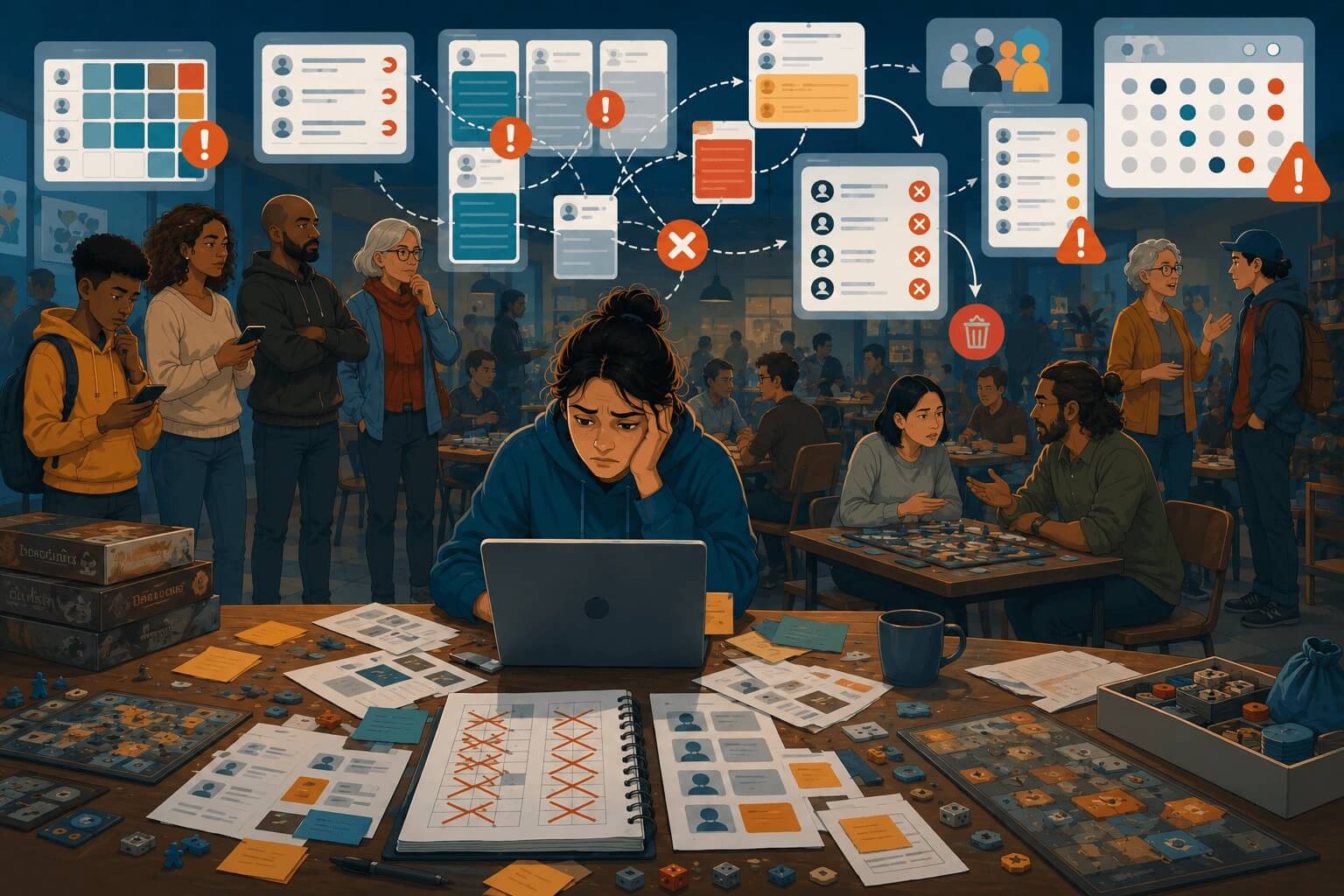
Board game communities depend on calm and predictable organization
Most organizers running Board game clubs are not trying to build loud, chaotic event businesses.
They usually care about atmosphere.
Consistency.
Fairness.
Community.
And creating recurring spaces where people can disconnect from stress and comfortably enjoy shared hobbies together.
That is especially true inside many modern Board game clubs, where organizers often naturally prioritize harmony, thoughtful structure, recurring social stability, and low-conflict community management.
The problem is that recurring operational complexity slowly grows in the background whether organizers enjoy administration or not.
At first everything feels manageable manually.
Then recurring attendance grows.
Waitlists appear.
Recurring scheduling conflicts accumulate.
Cancellations affect table balance.
Certain recurring game nights become overcrowded while others remain partially empty.
And suddenly the relaxing hobby environment slowly starts generating operational stress for the organizers themselves.
Waitlists quickly become emotionally exhausting for hobby organizers
One of the first serious operational challenges growing communities encounter is board game event waitlist management.
Because tabletop gaming communities often rely on limited physical capacity.
Limited tables.
Limited recurring campaigns.
Limited player slots.
Limited instructor or game master availability.
That means board game event waitlist management becomes surprisingly sensitive socially once recurring demand increases.
Players remember who received access.
They remember recurring exceptions.
They remember whether allocation felt fair or arbitrary.
And many organizers dislike confrontation strongly enough that they silently absorb the scheduling pressure themselves instead of introducing structured recurring systems early enough.
Balancing recurring tabletop groups becomes harder over time
As gaming communities grow larger, recurring tabletop session balancing becomes increasingly difficult manually.
Some recurring sessions become extremely popular.
Others fluctuate unpredictably.
Campaign continuity matters.
Player chemistry matters.
Recurring social dynamics matter enormously.
That means recurring tabletop session balancing is not simply an attendance problem.
It directly affects the quality of the gaming experience itself.
And unfortunately, once multiple recurring groups operate simultaneously, manual balancing slowly becomes operationally exhausting.
Fair rotation becomes critical in recurring gaming communities
One of the fastest ways to create hidden frustration inside hobby communities is unfair recurring access.
This is exactly why fair rotation scheduling for gaming groups matters much more than many organizers initially assume.
Recurring participants quietly notice patterns.
Who always receives preferred spots.
Who always gets late access.
Who receives recurring priority handling.
That is why fair rotation scheduling for gaming groups becomes essential for maintaining long-term community trust.
Especially in quieter communities where participants may avoid direct confrontation but still slowly disengage emotionally when recurring allocation feels unfair.
Attendance balancing becomes operationally draining for organizers
Many communities underestimate how difficult recurring club attendance balancing becomes over time.
Different players have different recurring availability.
Certain recurring game formats attract different audience sizes.
Campaign continuity creates additional recurring dependencies between participants.
And cancellations create chain reactions affecting multiple tables simultaneously.
That is why recurring club attendance balancing eventually requires structured recurring automation rather than permanent manual coordination through spreadsheets and messaging threads.
Otherwise organizers slowly become trapped inside operational maintenance instead of enjoying the hobby community they originally wanted to build.
Cancellations create hidden instability in recurring gaming nights
One of the most frustrating recurring operational problems is handling cancellations in gaming events.
Because tabletop sessions often depend on stable player composition.
A single cancellation can affect:
- table balance,
- campaign continuity,
- player count requirements,
- game preparation,
- and overall social atmosphere.
That means handling cancellations in gaming events requires much more than simple attendance tracking.
It requires recurring systems capable of preserving group stability while still remaining flexible enough for real-life scheduling changes.
Recurring booking conflicts slowly damage community trust
As recurring communities expand, recurring board game booking conflicts become increasingly common.
Players accidentally double-book recurring sessions.
Groups compete for preferred dates.
Recurring campaigns overlap operationally.
Popular recurring nights become overloaded.
The danger is that recurring board game booking conflicts slowly create unnecessary tension inside communities that originally existed precisely to help people relax socially.
And many organizers naturally avoid strict confrontation-heavy management styles, which often means the operational pressure quietly accumulates behind the scenes instead.
Limited seating requires calm operational structure
Many hobby organizers underestimate how stressful managing limited seats in tabletop sessions becomes once recurring attendance stabilizes at high levels.
Because recurring tabletop groups often rely on very specific participant numbers.
Too many players damages the experience.
Too few players may collapse the session entirely.
This is why managing limited seats in tabletop sessions requires recurring operational consistency and transparent allocation logic.
Otherwise organizers slowly become permanent mediators between recurring participants competing for limited recurring access.
Recurring hobby groups naturally accumulate scheduling complexity
Many organizers discover too late that recurring hobby group scheduling problems accumulate gradually rather than appearing all at once.
At first:
- a few recurring attendance changes,
- some waitlist handling,
- a few recurring campaigns,
- and occasional cancellations
all feel manageable manually.
Then recurring operational complexity slowly compounds month after month.
That is why recurring hobby group scheduling problems eventually become exhausting even for highly organized and community-oriented organizers.
Recurring gaming groups need specialized recurring booking systems
Most generic event tools are not designed for the recurring complexity of hobby communities.
This is exactly why many organizers eventually need a dedicated booking system for recurring gaming groups.
Recurring campaigns.
Stable player groups.
Recurring attendance balancing.
Waitlists.
Recurring allocation fairness.
All of these require much more than basic event registration logic.
That is why a proper booking system for recurring gaming groups becomes operational infrastructure protecting the long-term health of the community itself.
Fair access matters enormously in recurring game nights
As communities mature, fair access to recurring game nights becomes increasingly important socially.
Recurring participants need to trust that:
- allocation remains fair,
- waitlists are handled transparently,
- recurring attendance rules remain consistent,
- and recurring access is not determined emotionally or arbitrarily.
That is why fair access to recurring game nights becomes critical for maintaining low-conflict, stable hobby communities over the long term.
Especially for organizers who naturally prefer calm environments rather than constant interpersonal tension around scheduling decisions.
Bookcessful helps gaming communities reduce operational stress
Bookcessful was designed specifically for recurring operational ecosystems where fairness, recurring attendance stability, and recurring scheduling coordination must coexist smoothly.
Instead of manually reorganizing recurring attendance every week, gaming communities can automate recurring bookings, recurring attendance balancing, cancellations, waitlists, recurring allocation handling, and recurring session coordination.
This allows organizers to focus on community experience instead of permanent scheduling administration.
You can start using Bookcessful completely free for up to 30 days here:
https://bookcessful.com/en/register
The completely free trial helps gaming communities stabilize recurring operational complexity without immediate technical risk or workflow disruption.
No recurring spreadsheet chaos.
No recurring attendance confusion.
No unnecessary scheduling tension inside the community.
You can also explore recurring gaming group setup options here:
https://bookcessful.com/en/create-event
Or compare recurring operational plans here:
https://bookcessful.com/en/pricing
Many organizers first begin with the completely free 30-day trial simply to stabilize recurring attendance handling and recurring tabletop balancing before scaling further.
You can register for the completely free trial here:
https://bookcessful.com/en/register
You can also start building recurring gaming community systems immediately here:
https://bookcessful.com/en/create-event
Or review recurring automation pricing and scalability here:
https://bookcessful.com/en/pricing
Because hobby communities are supposed to reduce stress.
Not quietly create operational frustration for the very organizers trying to hold them together.
Comments
Comments are shown after moderation, similar to a classic public blog.
0 comments
There are no approved comments yet.