essay
Your Choir Cannot Sound Harmonious If Scheduling Chaos Keeps Breaking Rehearsal Stability
May 24, 2026
Choirs and recurring music groups depend on consistency, attendance stability, and predictable rehearsal organization. Scheduling chaos, cancellations, and recurring attendance imbalance quietly destroy rehearsal quality and community trust.
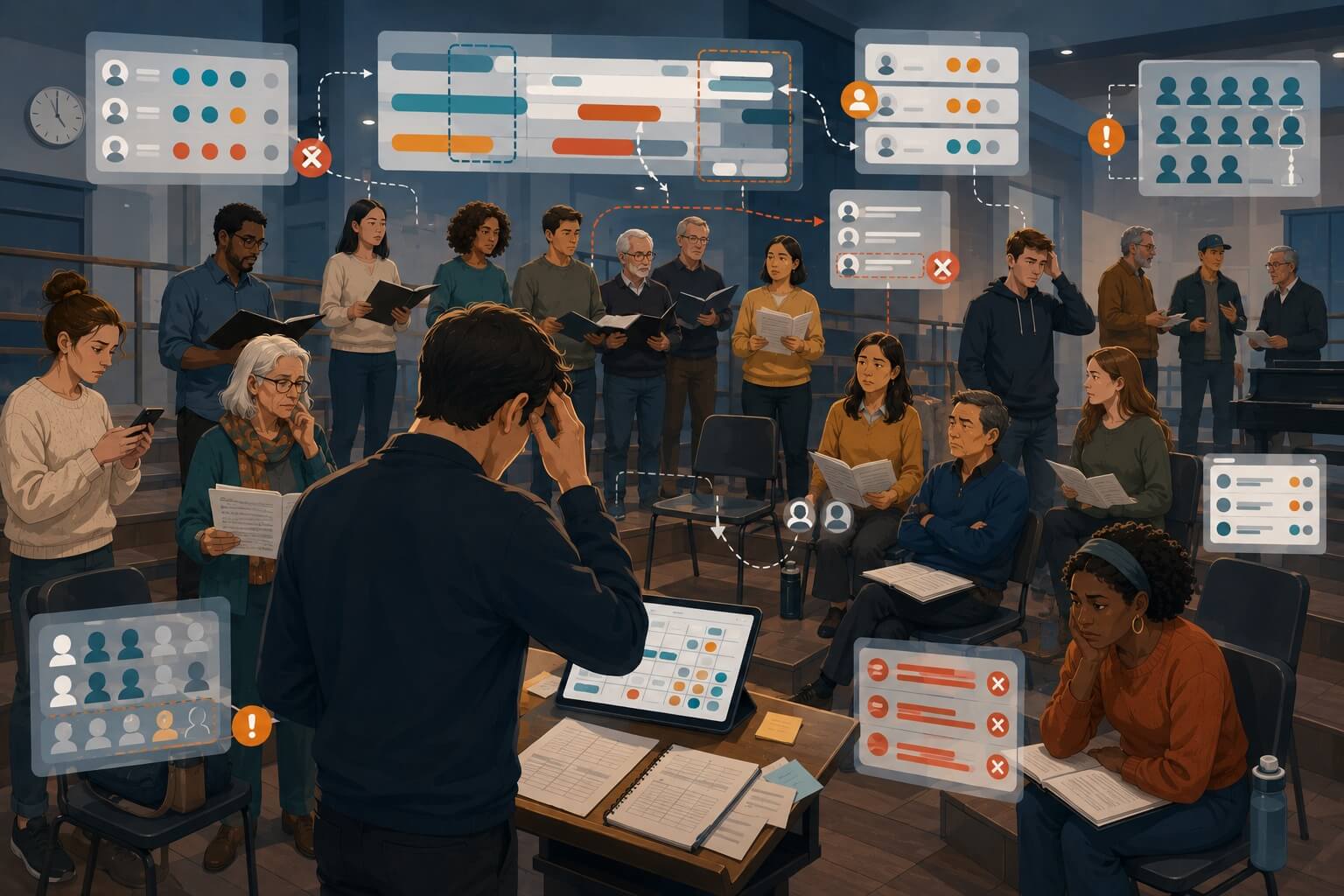
Music groups depend on recurring stability far more than most organizers realize
Most recurring music communities are built on consistency.
Consistency of attendance.
Consistency of rehearsal rhythm.
Consistency of recurring participation.
And consistency of group dynamics over time.
That is especially true inside Choir / music rehearsal environments, where musical quality depends heavily on recurring coordination between people rather than isolated individual performance.
Inside many Choir / music rehearsal programs, even small operational instability quickly becomes audible.
Missing voices.
Imbalanced sections.
Disrupted rehearsal flow.
Uneven recurring participation.
Late attendance changes.
And unfortunately, organizers often absorb all this operational pressure manually behind the scenes for far too long.
At first, recurring scheduling complexity feels manageable.
Then multiple ensembles appear.
Different rehearsal schedules overlap.
Recurring attendance becomes unpredictable.
And suddenly the artistic experience itself begins suffering because operational systems can no longer keep up.
Choir scheduling problems slowly destroy rehearsal consistency
One of the biggest recurring operational challenges music organizers face is simple choir rehearsal scheduling problems.
At first these issues appear small:
- a few attendance conflicts,
- some recurring cancellations,
- a few rescheduled rehearsals,
- or occasional recurring overlap problems.
But over time, choir rehearsal scheduling problems accumulate gradually until organizers spend more time coordinating attendance than actually focusing on musical direction.
And unlike ordinary events, rehearsal instability directly damages musical progress itself.
Because ensembles require recurring continuity to improve together.
Balancing music groups becomes increasingly difficult as communities grow
As ensembles expand, recurring music group balancing becomes operationally exhausting manually.
Different voice sections fluctuate differently.
Some rehearsals become overcrowded.
Others suddenly lack enough recurring participants.
Recurring instrumental groups may require highly specific participant ratios.
That means recurring music group balancing affects not only logistics but also rehearsal quality itself.
And unfortunately, many organizers continue trying to solve increasingly complex recurring balancing issues through spreadsheets, inbox threads, and manually updated attendance sheets.
Attendance management quietly becomes a full-time responsibility
Many organizers underestimate how difficult managing recurring rehearsal attendance becomes once multiple recurring groups operate simultaneously.
Participants change availability constantly.
Different rehearsal intensities attract different commitment levels.
Concert preparation periods increase attendance pressure dramatically.
At that point, managing recurring rehearsal attendance slowly turns into permanent operational maintenance work behind the scenes.
And because many music organizers are highly community-oriented, they often avoid strict enforcement or confrontation-heavy attendance systems even when recurring instability becomes damaging.
Cancellations create chain reactions inside recurring ensembles
One of the hardest operational realities is handling cancellations in choir rehearsals.
Because cancellations inside music groups rarely affect only one person.
A single missing participant may affect:
- harmonic balance,
- voice section stability,
- instrument distribution,
- repertoire progress,
- and rehearsal effectiveness.
That is why handling cancellations in choir rehearsals requires much more than basic attendance tracking.
It requires recurring systems capable of stabilizing ensemble continuity without overwhelming organizers operationally every single week.
Recurring music communities eventually require automation
As rehearsal ecosystems become more complex, recurring musician scheduling automation becomes increasingly necessary.
Because recurring rehearsal structures naturally accumulate complexity over time.
Multiple ensembles.
Recurring concert preparation cycles.
Different attendance reliability levels.
Recurring venue limitations.
Section balancing requirements.
That means recurring musician scheduling automation eventually becomes infrastructure protecting the long-term stability of the music community itself.
Otherwise organizers slowly become trapped inside operational coordination instead of musical leadership.
Fair rehearsal access matters more than many organizers assume
One hidden source of recurring tension inside music communities is unfair allocation.
This is exactly why fair rotation scheduling for rehearsal groups matters enormously.
Participants notice recurring patterns quickly.
Who receives preferred rehearsal access.
Who consistently receives recurring scheduling flexibility.
Who always ends up excluded from limited rehearsal opportunities.
That is why fair rotation scheduling for rehearsal groups becomes critical for maintaining long-term trust and low-conflict community dynamics.
Especially in artistic communities where organizers often prioritize harmony and social cohesion strongly.
Choir attendance balancing directly affects performance quality
One of the most difficult recurring operational tasks is balancing recurring choir attendance.
Because choir quality depends heavily on recurring section stability.
Missing altos change harmonic structure.
Missing tenors affect balance.
Uneven recurring attendance disrupts rehearsal continuity.
That means balancing recurring choir attendance directly affects both artistic quality and participant experience simultaneously.
And unfortunately, manual balancing eventually becomes nearly impossible efficiently once rehearsal ecosystems scale beyond small hobby groups.
Recurring orchestra scheduling chaos slowly overwhelms organizers
Larger ensembles eventually encounter severe recurring orchestra scheduling chaos.
Different instrument groups have different recurring availability.
Venue scheduling overlaps appear.
Concert preparation creates additional recurring complexity.
Different rehearsal intensities affect attendance reliability.
That is why recurring orchestra scheduling chaos often becomes emotionally exhausting for organizers long before participants fully realize how much operational work is happening invisibly behind the scenes.
And many organizers continue absorbing this pressure silently because they care deeply about preserving the musical community itself.
Waitlists become increasingly sensitive in limited rehearsal environments
As rehearsal capacity becomes limited, music rehearsal waitlist management becomes increasingly important operationally.
Certain ensembles become more popular than others.
Limited rehearsal rooms create recurring capacity constraints.
Concert-focused groups often attract recurring excess demand.
This means music rehearsal waitlist management eventually requires transparent recurring allocation systems capable of protecting fairness and recurring participation stability simultaneously.
Otherwise recurring frustration slowly accumulates inside the community.
Music groups need recurring booking systems designed for continuity
Most generic event systems are not designed for the complexity of recurring artistic communities.
This is exactly why many organizations eventually require a dedicated recurring vocal group booking system.
Recurring rehearsals are fundamentally different from one-time events.
Attendance continuity matters.
Section stability matters.
Long-term recurring participation matters.
That is why a proper recurring vocal group booking system becomes operational infrastructure supporting both rehearsal quality and community cohesion simultaneously.
Bookcessful helps recurring music communities reduce operational overload
Bookcessful was designed specifically for recurring operational ecosystems where recurring attendance stability, fairness, and recurring scheduling coordination must coexist smoothly.
Instead of manually reorganizing recurring attendance every week, music communities can automate recurring rehearsal bookings, recurring attendance balancing, cancellations, recurring allocation handling, waitlists, and recurring ensemble coordination.
This allows organizers to focus on music rather than permanent scheduling administration.
You can start using Bookcessful completely free for up to 30 days here:
https://bookcessful.com/en/register
The completely free trial allows music organizations to stabilize recurring rehearsal coordination without immediate operational risk.
No recurring spreadsheet chaos.
No recurring attendance confusion.
No invisible operational overload slowly exhausting organizers behind the scenes.
You can also explore recurring rehearsal setup options here:
https://bookcessful.com/en/create-event
Or compare recurring operational plans here:
https://bookcessful.com/en/pricing
Many recurring music communities first begin with the completely free 30-day trial simply to stabilize recurring rehearsal coordination and recurring attendance balancing before scaling further.
You can register for the completely free trial here:
https://bookcessful.com/en/register
You can also start building recurring rehearsal systems immediately here:
https://bookcessful.com/en/create-event
Or review recurring automation pricing and scalability here:
https://bookcessful.com/en/pricing
Because recurring music communities are supposed to create harmony together.
Not quietly collapse under invisible scheduling chaos behind the scenes.
Comments
Comments are shown after moderation, similar to a classic public blog.
0 comments
There are no approved comments yet.