essay
Free Booking System vs Scheduling App: What Breaks When Your Calendar Is Full
February 23, 2026
Looking for a free booking system or free scheduling app? Discover real search demand, hidden limitations of free tools, and how to choose the right solution when events fill up.
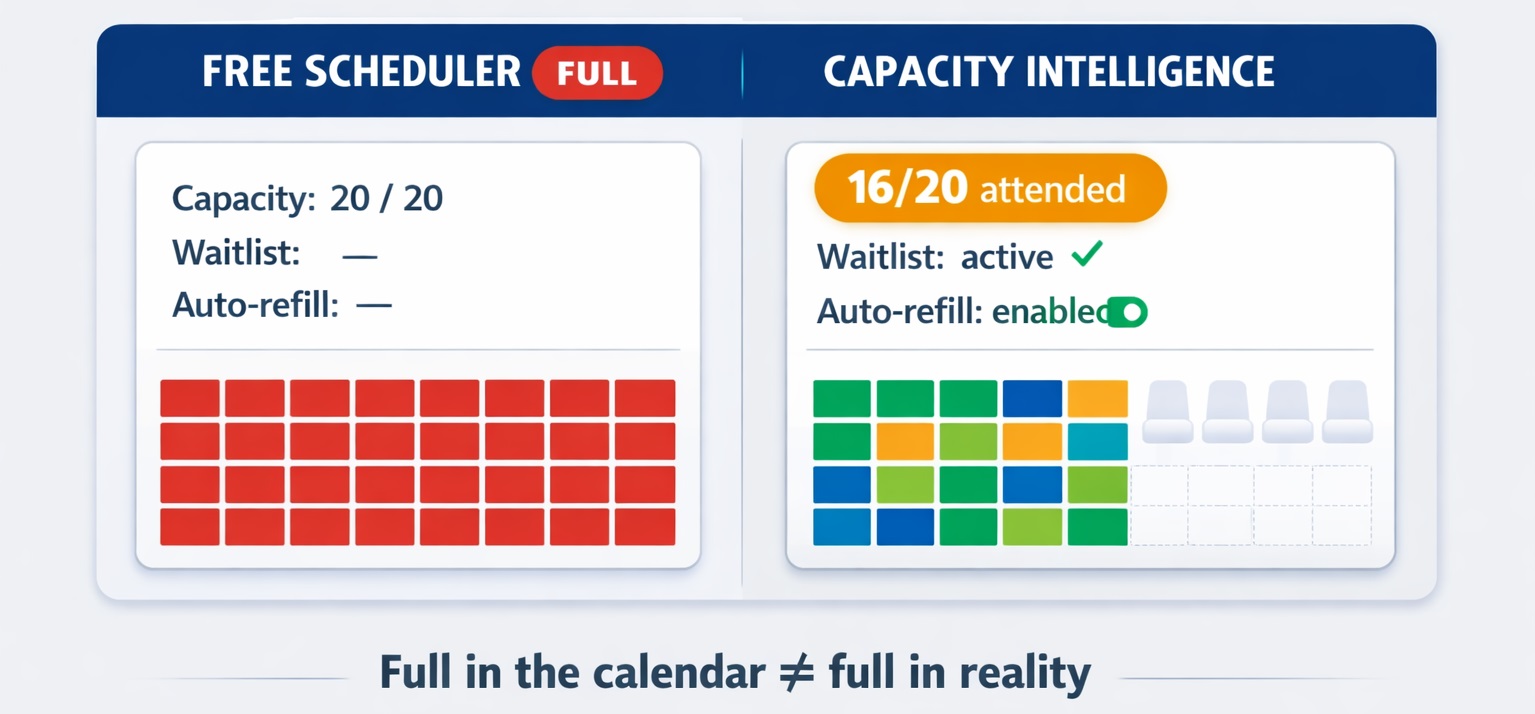
Free booking systems and scheduling apps are often the first step when organizing bookings.
For simple, predictable use cases, they work well.
The real problem starts when your calendar fills up — and your system cannot fill cancelled spots or manage who gets the next available place.
Free, but a real account (not just a demo). No Credit card needed.
In other words: this is not a niche curiosity. It is a steady, intent-driven demand segment made up of users actively looking for low-cost or zero-cost scheduling solutions.
If you are still evaluating the basics of booking technology, it helps to first understand what a booking system actually does — and where simple scheduling tools begin to fall short.
Why So Many People Search for Free Scheduling Tools
The intent behind “free” searches is usually very practical. Most organizers want to:
- validate their business idea before investing,
- replace manual email or spreadsheet booking,
- launch quickly without technical overhead,
- avoid recurring software costs early on.
Search demand for a free booking system or free scheduling app keeps growing — and the data clearly confirms it. Keyword research shows that the phrase “booking system free” generates roughly 5,400 searches per month, with seasonal spikes reaching nearly 9,900 monthly searches. (Source: MicroSaaS HQ)
Market analysis shows the space is crowded with freemium tools, yet comparison-style content (for example, “Top free booking systems”) can still rank well when it answers real operational questions. (Source: MicroSaaS HQ)
Where Free Booking Systems Usually Work Well
A free scheduling app is often perfectly adequate if your operation is simple and predictable. Typical good-fit scenarios include:
- 1-on-1 appointments with fixed time slots
- low daily booking volume
- no waitlist requirements
- minimal last-minute cancellations
- no group capacity management
The Hidden Breakpoint: When Events Start Filling Up
The real stress test comes when demand exceeds available spots. This is especially common in:
- workshops and training sessions,
- fitness or yoga classes,
- therapy groups,
- education programs,
- high-demand recurring events.
At this point, the question is no longer just scheduling. It becomes capacity management.
Many organizers only discover this difference after hitting the “full” state in their calendar.
What Most Free Scheduling Apps Do NOT Handle Well
- no intelligent waitlist handling
- no automatic backfilling of cancellations
- limited support for group capacity logic
- weak handling of late cancellations and no-shows
- minimal automation when demand fluctuates
The Real Cost of “Free” in High-Demand Situations
The software itself may be free — but unused capacity is not.
When cancellations happen close to the event start time, simple scheduling tools usually lack the logic to refill those spots efficiently.
Why “Free” Traffic Still Matters
From a growth perspective, the “free booking system” keyword space sits in a moderate difficulty zone, meaning focused pages can realistically reach page 1–3 with well-structured content. (Source: MicroSaaS HQ)
Top Free Booking Systems (Quick Comparison)
If you are evaluating options, here is a practical snapshot of popular free scheduling tools and where they typically fit.
| Tool | Best for | Free plan limits | Group capacity handling |
|---|---|---|---|
| Calendly | 1-on-1 appointments | Limited event types | Basic |
| SimplyBook.me | Service businesses | Feature caps | Partial |
| Setmore | Small teams | User limits | Limited |
| Bookcessful | Capacity-driven events | Free trial available | Advanced waitlist logic |
The key takeaway: most free tools are optimized for calendar coordination. Only a few platforms are designed primarily around capacity intelligence.
Bottom Line
Searching for a free booking system is a logical first step — and the search data proves the demand is real.
If you only need calendar coordination, many free scheduling apps will serve you well. If your challenge is maximizing attendance in high-demand group events, the real question is whether your system can intelligently manage capacity when demand peaks.
Comments
Comments are shown after moderation, similar to a classic public blog.
0 comments
There are no approved comments yet.