research
How to Reduce No-Shows Without Becoming a Full-Time Reminder Service
June 4, 2026
Discover practical ways to reduce no-shows in workshops, therapy groups, classes, and recurring events. Learn how reminders, waitlists, and smarter booking systems help protect attendance and capacity.
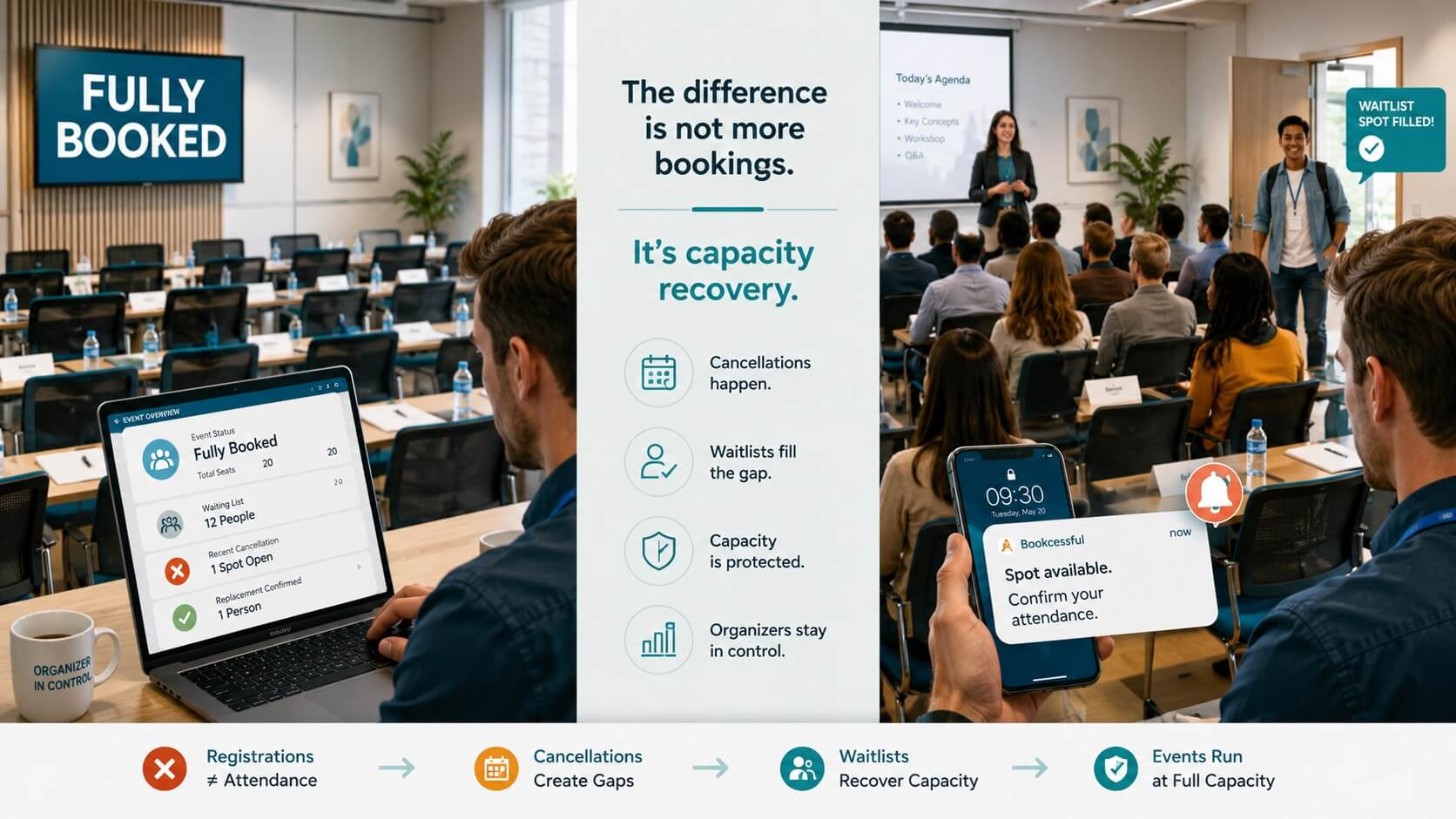
Few things are more frustrating than seeing a fully booked event slowly fall apart as the date approaches. People register enthusiastically. Your calendar looks full. Capacity appears to be utilized. Then the cancellations begin. Some attendees cancel at the last minute. Others simply do not show up at all.
For organizers of workshops, training programs, therapy groups, educational events, coaching sessions, and recurring classes, no-shows create a problem that goes far beyond empty chairs.
Every missed attendance slot represents lost revenue, disrupted group dynamics, wasted preparation time, and opportunities that could have gone to someone else.
Many organizers respond by manually sending emails, making phone calls, chasing confirmations, or maintaining spreadsheets to track attendance. The result is often a significant administrative burden without fully solving the problem.
The good news is that reducing no-shows does not require becoming a full-time reminder service. It requires understanding why no-shows happen and building systems that address those causes before they become expensive.
Why People Miss Events They Intentionally Booked
Most no-shows are not caused by bad intentions.
People register because they genuinely want to attend. The problem is that registration often happens days, weeks, or even months before the event itself.
Between registration and attendance, life happens.
- Schedules change.
- Work priorities shift.
- Family obligations arise.
- People forget.
- The event loses urgency in their mind.
- Another commitment appears.
In many cases, attendees are not actively deciding not to come. They simply fail to take action when circumstances change.
This distinction is important because it means that many no-shows are preventable.
The Hidden Cost of No-Shows
Most organizers focus on the visible loss: an empty seat.
However, the real cost is often much larger.
Imagine a workshop with twenty available places.
If five attendees fail to appear, the problem is not only the five empty seats. Those places were unavailable to other interested participants during the registration period. Potential attendees may have been turned away because the event appeared fully booked.
The result is a double loss:
- the registered attendee does not come;
- the replacement attendee never gets the opportunity.
This is exactly the situation explored in How to Handle Fully Booked Events Without Losing Control.
A full calendar is not always a full event.
Research: What Actually Reduces No-Shows?
The challenge of missed appointments and event attendance has been studied extensively across healthcare, education, and service industries.
One of the earliest controlled studies found that reminder systems reduced no-show rates from 24% to 14%, representing a substantial improvement in attendance. Letter reminders and telephone reminders both produced positive results.
More recent systematic reviews continue to show consistent benefits from reminders. Research examining multiple reminder methods found that reminder systems reduce non-attendance rates by roughly one-third on average.
Studies also indicate that multiple reminders often outperform a single reminder, particularly when combined with easy confirmation or cancellation options.
More importantly, modern systems are moving beyond simple reminders. Research shows that predictive attendance models, automated communication, and proactive outreach can improve attendance rates while increasing overall capacity utilization.
The lesson is clear:
People do not need more reminders because they are irresponsible. They need systems that help them follow through on intentions they already had.
Reminder Timing Matters More Than Most Organizers Think
A reminder sent immediately after registration is rarely enough.
When someone books an event six weeks in advance, a confirmation email sent six weeks before the event has almost no impact on attendance.
Effective attendance management treats reminders as a sequence rather than a single message.
A typical pattern might include:
- confirmation immediately after booking;
- reminder several days before the event;
- final reminder shortly before attendance.
This keeps the commitment visible and gives attendees time to either confirm participation or cancel early enough for someone else to take the place.
Research Findings: What the Data Says About Reducing No-Shows
No-shows have been studied extensively across healthcare, education, and appointment-based services because they create the same underlying problem: reserved capacity that ultimately goes unused.
One of the most frequently cited controlled studies found that reminder systems reduced no-show rates from 24% to 14%, representing a 42% relative improvement in attendance. Source: PubMed – Effectiveness of Appointment Reminders
Subsequent systematic reviews reached similar conclusions. Reminder systems delivered through SMS, phone calls, or automated notifications consistently improve attendance rates across multiple industries. Source: National Library of Medicine – Appointment Reminder Systems Review
Research also indicates that multiple reminders generally outperform a single reminder, especially when attendees can easily confirm or cancel. Source: National Library of Medicine – Digital Reminder Effectiveness
More recent studies show that organizations achieve the greatest gains when reminders are combined with capacity recovery mechanisms such as waitlists and rapid rebooking workflows. Source: AI-Assisted Appointment Management Study
What These Findings Mean for Event Organizers
| Common Cause of No-Shows | Research Insight | Practical Response |
|---|---|---|
| People forget about the event | Reminder systems consistently improve attendance rates. | Use automated email and SMS reminders before the event. |
| Long time between booking and attendance | Long lead times are among the strongest predictors of no-shows. | Keep attendees engaged between registration and attendance. |
| Schedules change after registration | Many cancellations are unavoidable even when reminders are used. | Make cancellations simple and visible. |
| Late cancellations leave empty seats | Capacity losses occur when cancelled places cannot be reassigned quickly. | Use automated waitlists to refill released places. |
| Single reminder emails are ignored | Multiple notifications generally outperform a single reminder. | Send a sequence of reminders instead of only one confirmation email. |
| Manual attendance management does not scale | Scheduling systems improve utilization when reminders and rebooking are automated. | Automate attendance management wherever possible. |
| Fully booked events still end up half full | Reducing no-shows alone does not maximize capacity utilization. | Combine reminders with waitlist-based capacity recovery. |
flowchart TD

A["Booking
completed"]

B["Automated
reminders"]

C{"Still able
to attend?"}

D["Attendance
confirmed"]

E["Cancellation
received"]

F["Waitlist
activated"]

G["Next person
invited"]

H["Place
filled"]

I["Event runs
at planned
capacity"]

A --> B

B --> C

C -- Yes --> D

C -- No --> E

D --> I

E --> F

F --> G

G --> H

H --> I
Figure: The most effective no-show strategy combines prevention (reminders) with recovery (waitlist-driven capacity replacement).
Why Waitlists Are One of the Best Defenses Against No-Shows
Even the best reminder system cannot eliminate every cancellation.
Life remains unpredictable.
The real question is what happens after a cancellation occurs.
Without a waitlist, the place often remains empty.
With a waitlist, a cancellation becomes an opportunity.
Someone who still wants to attend can be invited automatically, filling capacity that would otherwise be lost.
This approach changes the objective completely.
Instead of trying to achieve perfect attendance, the goal becomes maintaining full capacity despite inevitable changes.
That principle is explained in greater detail in Waitlist Management Best Practices: How to Stay in Control When Demand Exceeds Capacity.
The Problem With Manual Attendance Management
Many organizers attempt to solve no-shows manually.
Initially this seems reasonable.
A few emails. A few reminders. A spreadsheet. A phone call or two.
The problem emerges as demand grows.
The administrative workload increases faster than the event capacity itself.
Every additional participant creates more communication tasks, more tracking, more follow-up, and more opportunities for human error.
At some point the organizer becomes the bottleneck.
Instead of focusing on delivering a great event, they spend time managing attendance logistics.
Booking Systems Help. Capacity Management Helps More.
Many organizations eventually adopt an online booking system.
That is an important step, but it does not solve the entire problem.
A booking system handles registration.
Capacity management handles what happens after registration.
There is a significant difference.
If an event becomes fully booked, capacity management continues working:
- tracking available places;
- handling cancellations;
- managing waitlists;
- offering places to replacement attendees;
- keeping attendance levels stable.
If you are evaluating different approaches, it is worth understanding the distinction explained in Booking System vs Capacity Management: What Happens When an Event Is Full?.
Special Challenges for Therapy Groups, Classes, and Recurring Programs
Some environments are affected by no-shows more than others.
Therapy groups, educational cohorts, support groups, and recurring programs depend heavily on attendance consistency.
The absence of a participant affects not only capacity but also the experience of everyone else in the group.
Facilitators often need predictable participation patterns to maintain rhythm, continuity, and trust.
For these organizations, reducing no-shows is not merely a financial issue.
It is a quality-of-service issue.
This is one reason why attendance management is particularly important for organizations such as therapy groups that rely on consistent participation and predictable group rhythm.
The Most Effective No-Show Strategy Is Prevention Plus Recovery
Many attendance strategies focus exclusively on prevention.
Send reminders. Reduce forgetfulness. Increase commitment. Encourage confirmations.
All of these matter.
But real-world attendance management requires a second layer:
recovery.
People will still cancel. Emergencies will still happen. Schedules will still change.
The organizations that maintain high attendance rates are not the ones that eliminate every cancellation.
They are the ones that recover quickly when cancellations occur.
That means combining:
- automated reminders;
- simple confirmation processes;
- easy cancellation options;
- automated waitlist management;
- fast replacement workflows.
Final Thoughts
No-shows are not simply an attendance problem.
They are a capacity problem.
The traditional response has been to remind people more often and work harder administratively.
The more scalable approach is to create systems that protect capacity automatically.
When reminders help attendees keep commitments, waitlists replace cancelled places, and capacity is managed continuously rather than manually, attendance becomes more predictable and events become more resilient.
That is the difference between managing bookings and managing capacity.
If you are still relying on manual tracking, spreadsheets, and last-minute emails, it may be worth first understanding what a booking system actually does —and what it does not.
Comments
Comments are shown after moderation, similar to a classic public blog.
0 comments
There are no approved comments yet.